Termite Inspection and Treatment in Tampa Bay
Drywood, eastern subterranean, Formosan and Asian subterranean termites in Hillsborough and Pinellas: inspection, tenting or spot treatment, soil treatment and baits, and what the warranty should say. Call now.
Tampa Bay has every termite Florida has. Drywood termites live inside the wood of the older houses and fly from April into June, and on warm evenings later in the summer. Eastern subterranean termites nest in the soil under slabs and crawl spaces across both counties and fly from January into April, on warm afternoons after rain. Formosan subterranean termites, the large, fast colonies that can build nests above ground, are established around the bay and fly after sunset from April to June, with May the peak. Asian subterranean termites, the tropical species that used to stop in South Florida, were confirmed in South Tampa in 2023 and fly at dusk from February to April.
Which one you have decides everything that follows: the inspection, the treatment, the warranty and the price. A quote that names a treatment before it names a species is a quote to walk away from.
Need an exterminator? Call 000-000-0000
Drywood or subterranean
Drywood termites need no soil contact. They live in the window frames, the fascia, the attic framing and the furniture, and they leave small piles of dry droppings like coffee grounds under a kick-out hole. Swarmers are the first sign most people see: winged insects at a window or a light, then shed wings on the sill.
Subterranean termites, eastern or Formosan, come up from the ground through mud tubes on the stem wall, the plumbing penetrations and the expansion joints of the slab. The damage is in the sill plate, the base of the door frames and the bottom of the drywall. Formosan colonies are big enough to hollow a structural member in months, and they can carry enough moisture to start a satellite nest in a roof leak or a wet wall, so a Formosan house gets inspected above ground as well as below.
Tent, spot treatment, soil treatment or baits
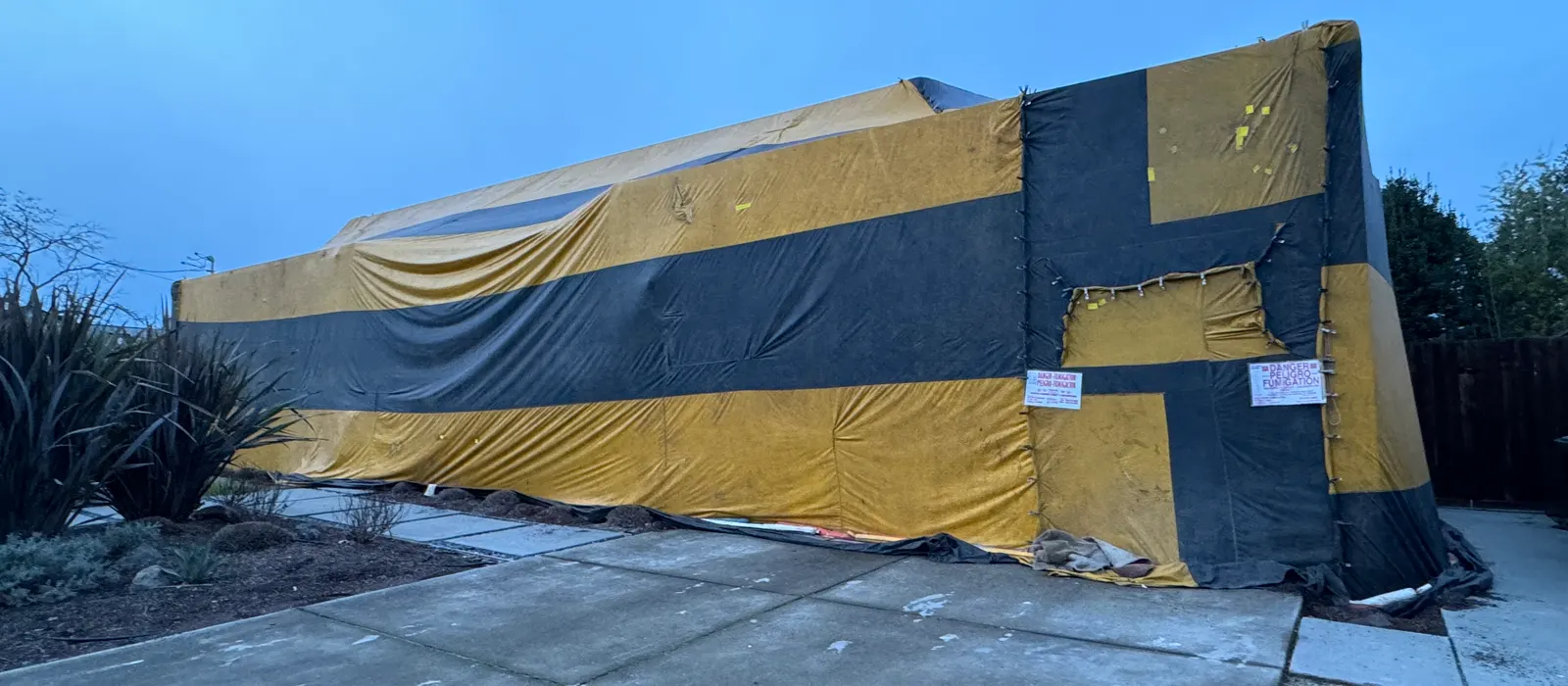
Structural fumigation, the tent, is the one treatment that reaches every drywood colony in a house, including the ones nobody found. It means two to three days out of the house, food and medicine bagged or removed, plants and pets out, the gas line shut and the house sealed under a tarp with warning signs posted. In Florida the company doing it holds the fumigation category on its license, and a licensed fumigator is in charge of the job.
Spot treatment, a borate or a foam injected into the galleries, works when the colonies are found and reachable, which is often the case in a single infested window frame or a section of fascia. Heat treatment of a room or a piece of furniture is another option. A proper drywood quote says which colonies were found, where, and why a tent is or is not needed.
Subterranean termites are never tented. They are treated in the soil, with a liquid termiticide trenched and injected around the foundation and drilled through the slab at the problem spots, or with bait stations set around the house and checked on a schedule, or both. Baits take months to kill a colony; liquids act faster but have to reach every entry. The company should say which it proposes and why for this house.
- Drywood: tent fumigation, or spot treatment when the colonies are found and reachable
- Subterranean, eastern: liquid soil treatment, bait stations, or both
- Formosan and Asian: soil treatment plus an above-ground inspection for satellite nests; bait programs sized for the colony
- Any species: moisture repairs, since a wet sill or a leaking roof is the invitation
The warranty
A termite treatment comes with a written agreement, usually renewable every year. A retreatment warranty means the company treats again if termites return. A repair warranty means it also pays for damage found after the treatment, up to a stated limit. The agreement says which it is, what the annual renewal costs, what inspections it includes and what voids it, which is often an untreated addition, a new slab, or a moisture problem that was pointed out and not fixed.
Ask for the warranty wording before the treatment, and keep the agreement with the house papers. A transferable termite warranty is a selling point in both counties.
The rules behind the quote
Termite work in Florida is licensed by the Department of Agriculture and Consumer Services under Chapter 482. The company holds a business license with the termite category, a certified operator is in charge, and every technician carries a state identification card. Fumigation is its own category with its own certified operator. The state publishes the license lookup, and a company should give its license number without being asked twice.
The wood-destroying-organism inspection a lender or a buyer asks for is a separate job on the state form, done by a licensed inspector; it is covered on its own page.